


Shotguns might well be the most commonly found type of firearm on the planet, from simple single-shot models in farmers’ sheds the world over to highly advanced tactical shotguns deployed by special operations forces.
Because of their relative simplicity and ubiquity, there are many types, calibers (called “gauges”), and styles within the broader category of shotguns which can make buying a shotgun overwhelming. This is especially true for folks new to firearms which, somewhat ironically, are very often recommended to “just buy a shotgun” as their first firearm.
Here, we’re going to demystify the world of shotguns. To do so, we’ll discuss four major types, from the most simple to the most complex in terms of their designs. For each type, we’ll briefly explain the mechanism and a use case for the design, before discussing a potential drawback of the design and offering an accessory that we would pick to make the gun most useful for its given purpose.
By the end of this, we hope that you have a clearer idea of what type of shotgun works best for you.
Break-Action Shotguns
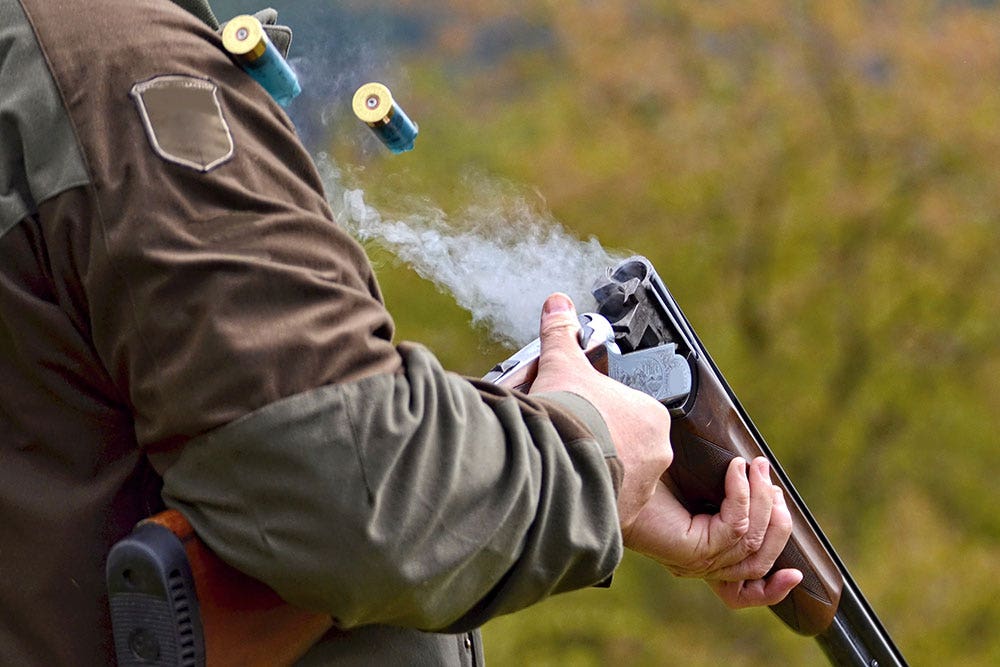
One of the oldest firearms designs still in production, break-action shotguns do what the name suggests: they break in half. This is on purpose, as these simple firearms hold only a single round in the chamber. Once that round has been fired,the simplest models require the user to remove the spent shells by hand, and slightly more mechanically complex guns have ejectors that spit out the spent shells when the action is opened.
In their most simple form, a single-shot break action shotgun only holds a single round: more commonly, these firearms have two barrels to effectively double the capacity of the weapon. Some models have two triggers (one for each barrel) and others have a single trigger that must be pulled twice to fire both rounds.
Over/under shotguns ( a type of break action where the barrels are aligned vertically with one over the other) are common for folks who shoot at clay pigeons or birds, and most places that allow any kind of hunting allow the use of these firearms. Models like the Tristar Trinity II come in a wood stock with a silvered receiver and blued barrel, a near-copy of designs that have been made for several hundred years. Of course, most major shotgun manufacturers now also make all-black models, or, sometimes, camo pattern guns that are specifically designed for hunting, often with a fiber optic front sight for ease of use.

The major drawback of this design is the lack of ammo capacity: at most, a double-barreled shotgun will hold two shells, one in each chamber. As many bird hunters will be happy to tell you, two shots are not many when shooting at a small, flying target. Learning how to reload accurately under stress is absolutely necessary for making good use of a break action, and the amount of training to do so well, repeatedly, and under less than ideal conditions (such as cold and rain) makes these a gun with a steep learning curve. If a break-action is going to be your first shotgun, training will be key, and taking classes is highly recommended, especially if you plan to use it for home defense.
To somewhat offset the capacity issue, we recommend pairing a break-action shotgun with a traditional trap shooting/bird hunting vest. These vests, importantly, have massive pockets in the front, which is where the shooter will store as many shells as they think they’ll need, which is still not exactly as convenient as other types of shotgun reloading procedures but is certainly better than a box of shells in the pocket of your pants.
Break-actions are still rugged and reliable designs by any measure, but their classic styling is met with classic capacity: one or two rounds at most.
Pump-Actions
A simple pump-action shotgun is one of the most capable firearms that anyone can own. These firearms (as the name suggests again) reload by pumping the fore-end back to eject the spent cartridge (or open the empty chamber) and forward again to lock a new round into the chamber. The action stays all in one piece with pump actions and, importantly, these shotguns are fed by a magazine tube under the barrel. This means that the capacity of a pump action is several times that of a break action, with some models now being able to fit ten or so standard shotgun shells.
While pump-actions can be set up to do nearly everything, we recommend them as a first, all-around gun to anyone interested in firearms generally, but not sure of exactly what they want to do. For instance, this specific version of Mossberg’s legendary Maverick 88 comes with a 28” barrel, which makes it great for hunting but a little unwieldy in close quarters for home defense. The good news is, that these shotguns are both simple to work on and have a great aftermarket of parts, so buying, for example, a 20” barrel and replacing it at home (or with the help of a local gunsmith) is a simple and relatively affordable matter, and the gun can be put quickly back into factory configuration. Pump-actions also tend to have many good budget-friendly options, which makes them an excellent entry point into the wider world of firearms.

One downside pump guns do have is that they are a lot of physical work to manipulate. The pumping action takes some strength, making them an issue for smaller or weaker shooters, and the necessity to pump the gun makes them, usually, a poor idea for folks with hand or arm-related disabilities.
A small way to cut down on that fatigue is not to have to carry the gun around all the time when hunting. Thus, we highly recommend a quality sling for pump actions: many models also have loops in the sling to store extra ammunition, which we appreciate when hunting or at the range, and would certainly come in handy for home defense.
For most first-time shotgun buyers, starting with a pump is the way to go. For a reasonable amount of money, you can get the gun, a second barrel, and enough ammunition so that you’ll be able to train and know what you want to do in terms of customizations or other types of shotguns.
Lever-Actions
For most shotgun designs, the clue to the mechanics of the gun is in the name, and that’s true for lever actions as well. Lever-action shotguns reload from a magazine tube much like pump-actions, but instead of the pump being on the fore-end, the user actuates a lever that is part of the trigger guard in order to eject the spent cartridge, pick up and load a new one of the magazine tube, and cock the hammer of the firearm for shooting.
Lever-actions are, in the hands of a trained shooter, among the fastest shotguns to shoot, which is why they are common in cowboy-action shooting competitions: they’re also historically linked to the time period just after the American Civil War when lever-actions were much more common than they are today. In terms of using them today, most folks will buy these to experience a bit of Old West Nostalgia, or to compete in the aforementioned competitions. But, a .410 Henry Lever Action Shotgun is also a more than capable pest-control tool that will be extremely reliable. The good thing about the relatively small caliber of most lever actions is that they also recoil much less than most other shotguns, making them a good introduction to shooting for those who might be recoil-sensitive.

The major weakness of the lever action is the action itself. The design of a lever action is slightly more complex and slightly weaker than any of the other designs we’ve discussed so far. This complexity, and associated increased cost, means that lever-actions have never been the most popular or widely available type of shotgun, though they have been popular among cowboy action shooters. Thus, most of what you are likely to find on the market today will be in relatively anemic calibers such as .410 (though there are some modern designs that use 12-gauge) which makes them easy to shoot, but not ideal for self-defense or large game hunting.
Since lever actions make such good pest control guns, we think that keeping one in a scabbard makes sense: a shotgun scabbard is a great way to mount these fun guns on a horse’s saddle, a backpack, or a rack on an ATV so that you can access them quickly while also keeping themechanism free of debris. These are fun guns, but the somewhat outdated design keeps them from serious tactical or hunting considerations in the 21st century.
Semi-Automatic
Most people first hear “semi automatic” in the context of rifles, where it means that the firearm fires one round per pull of the trigger. The same is true for shotguns: semi-automatic shotguns fire one shell with each pull of the trigger and reload without further intervention from the shooter assuming there are shells remaining in the magazine tube.
This much simpler-to-use action means that semi-automatic shotguns can be fired several times faster than any of the other designs discussed here. Because of this, semi-automatic shotguns are the new standard in hunting shotguns and are a growing choice for self-defense and military applications all over the world. The mechanisms require a little upkeep, but the payoff is that these are the fastest way to deliver 12-gauge rounds that most civilians can access today.

The major drawback for most people in terms of semi-automatic shotguns is the price. For many years, models such as the Beretta USA A400, which are excellent guns for hunting and competition, were the only option in the market and are still easily the gold standard for semi-auto shotguns, at several times the cost of a good pump-action shotgun. The price kept many folks from buying these but now that many Turkish and American manufacturers are learning how to make reasonably reliable semi-auto shotguns, the price on these will likely become more accessible in coming years.
In terms of accessories, we recommend a set of compatible choke tubes for a semi-automatic shotgun. From the factory, the Beretta above is set up to shoot flying targets such as clay pigeons, but, the swapping of a choke (which is a tube that screws into the barrel and directs the shotgun pellets into differently-sized patterns) can make the gun work well for hunting deer or self-defense as well, which is good considering the sheer cost of the gun.
Although semi-automatic shotguns have been around for over a century, which means that they are nothing new. For most of that time, they’ve been more expense than other designs. Now, the price of the high-end models keeps most new shooters from buying one, and the reliability issues some cheap models have make them a poor choice for new shooters. This will likely change in the future, however, as manufacturers out of Turkey and elsewhere have been lowering costs lately, and brands from the USA and Europe will likely follow suit to compete.
Conclusion
Here, we scratch the surface of shotguns. Of course, there is a lifetime of knowledge in terms of using and training with each type discussed here. But, based on a quick survey, we are willing to make some basic recommendations about each type of shotgun for different users.
New shooters should likely buy an affordable pump-action. These are very budget-friendly, highly reliable, and can be customized to fit your needs as you learn them through training. For new shooters, the ability to budget for and train with ammunition is at least as important as the choice of firearm.
For those who know they intend to do mostly bird hunting or trap shooting, a break-action might be an excellent choice. This is especially true in places where other types of shotguns are not legal for hunting purposes.
Lever-actions deliver a lot of fun per trigger pull, but the somewhat obsolete designs and old calibers make it such that these guns are mostly for fun and cowboy action competitions. We’d recommend them to people looking to add some style and flavor to an already well-rounded shotgun collection, but not as first guns.
Finally, semi-autos are some of the best shotguns on the planet. For folks with a good bit of firearms experience and some budget to spare, a high-quality hunting or tactical semi-auto is a major upgrade over cheaper pump-actions. The price might make them a little out of the realm of reason for brand-new shooters, but for some folks, this will be the right call.
Since there’s so much to learn about shotguns, the buying process can be overwhelming. Here at Green Top our Pros would love to talk through your needs on an individual basis to help pick the right gun for you. Feel free to come by or give us a call for more specific information!